
How long does knockdown texture last? A professionally installed knockdown texture pool deck typically lasts 10 to 15 years or more in Orange County, as long as the sealer on top is renewed every 2 to 3 years. Coastal decks in Newport Beach, Huntington Beach, and Laguna Beach usually need resealing closer to every 2 years because of salt air and marine-layer moisture. Inland decks in Anaheim, Irvine, and Mission Viejo can often stretch to 3 years with good care. The texture coat itself is rarely what fails first. The sealer wears down, and once it’s gone, sun, chlorine, and salt start working on the color and the surface underneath.
This guide covers what affects knockdown texture lifespan in Orange County’s two very different climates, the signs your deck needs resealing, a step-by-step resealing process, simple knockdown texture maintenance habits, and how to tell when it’s time to resurface instead.

Why Knockdown Texture Lifespan Depends on the Sealer
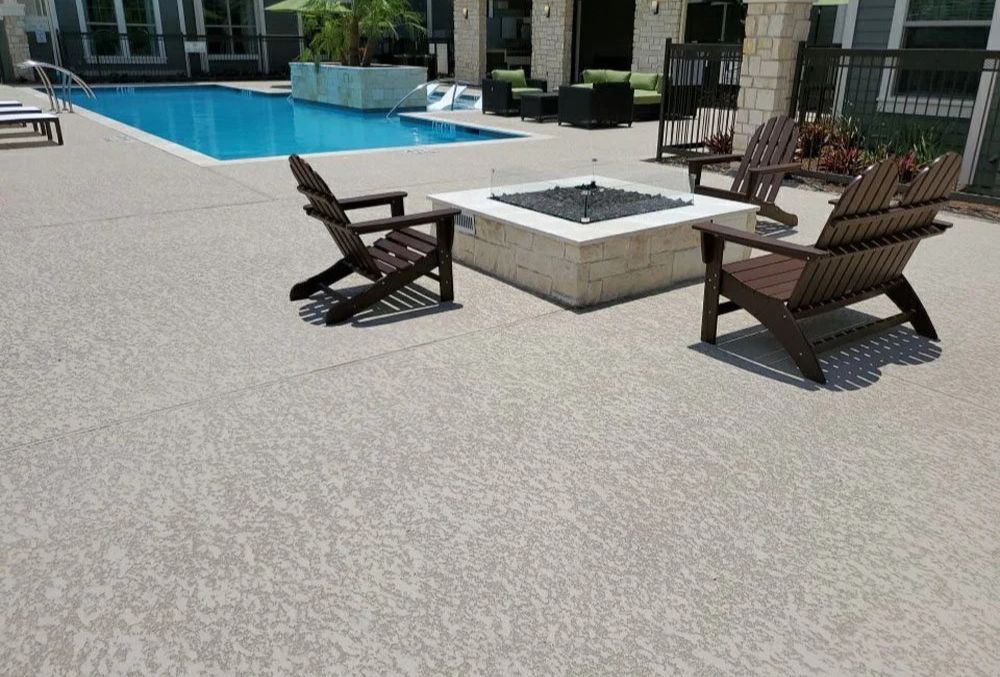
Knockdown texture is an acrylic-modified cement coating sprayed over existing concrete. Once the spray pass goes down, the crew “knocks down” the peaks with a trowel, which leaves the flattened, stucco-like pattern that stays cooler underfoot and grips well when wet. The coating bonds to the slab, so a well-prepared installation doesn’t simply wear away.
The sealer is the part that takes the daily abuse. It blocks UV, keeps chlorine and pool water from soaking in, resists stains, and locks in the color. When it wears thin, the coating starts absorbing water and fading, and small chips appear on the texture peaks. That’s why the answer to “how long does knockdown texture last” is really two numbers: how long the coating lasts (10 to 15+ years) and how long the sealer lasts (2 to 3 years). Keep the second one on schedule and you protect the first. For more on choosing this finish for a pool, see our knockdown texture pool deck page.
How Long Does Knockdown Texture Last in Coastal vs. Inland Orange County?
Orange County packs two climates into one county, and each one wears a pool deck differently.
Add Your Heading Text Here
 Near the coast, the biggest threats are salt and moisture rather than heat. Salt air settles on the deck and gets drawn into the surface as it dries. The marine layer keeps shaded corners damp into late morning, which encourages mildew and white mineral deposits (efflorescence) near the coping. Temperatures are mild, so there’s less heat stress, but the sealer is under constant chemical pressure. Plan on resealing about every 2 years. Our guide to resurfacing a pool deck to resist salt air damage covers coastal finish choices in more detail.
Inland Orange County: Anaheim, Irvine, Orange, Yorba Linda, Mission Viejo
 Inland, UV and heat do most of the damage. Summer afternoons in the 90s heat the deck every day, and the coating expands and contracts as it cools overnight. South- and west-facing decks lose color fastest, and Santa Ana winds drive grit across the surface that slowly scuffs the sealer on walking paths. With regular cleaning, inland decks can usually go 2 to 3 years between reseals. Lighter colors and a UV-stable sealer help; see our article on UV-resistant concrete coatings in Orange County.
Saltwater Pools Anywhere in the County
 Salt chlorine generators are common in Orange County, and they change the maintenance math. Splash-out leaves salty water on the deck, and as it evaporates, salt crystals form inside the surface pores and push against the sealer. A quick freshwater rinse after heavy pool days, plus resealing on the shorter end of the range, keeps salt from shortening the life of the finish.
Setting | Main wear factors | Typical reseal interval |
Coastal OC | Salt air, marine-layer moisture, mildew, efflorescence | About every 2 years |
Inland OC | UV, summer heat, Santa Ana wind grit, color fade | Every 2–3 years |
Saltwater pool (any area) | Salt crystals forming in the surface from splash-out | Every 2 years, rinse often |
Shaded or sprinkler-wet decks | Constant moisture, mildew, mineral staining | Every 2 years; fix sprinkler overspray |
Beyond climate, a few other things decide whether a deck lands at the low or high end of the 10-to-15-year range: how well the original surface was prepared, how much foot traffic the deck gets, pool water chemistry, and whether the sealer was renewed on time.
Knockdown Texture vs. Cool Deck vs. Acrylic Overlay: Lifespan Compared
Homeowners comparing finishes often ask how knockdown texture holds up against other common pool deck surfaces. Here’s how they compare with professional installation and regular resealing.
Finish | Typical lifespan | Reseal / recoat | Where it wears first | Best for |
Knockdown texture | 10–15+ years | Every 2–3 years | Sealer on texture peaks in walking paths; color fade in full sun | Slip resistance, comfort underfoot, hiding minor imperfections |
Cool deck | 10–15 years | Every 2–3 years | Hairline cracking, chalking, staining | The coolest possible surface on hot inland decks |
Acrylic overlay (smooth, stamped, or stenciled) | 8–15 years | Every 2–3 years | Scuffing and sealer wear show sooner on smoother surfaces; can get slick if over-sealed | Decorative patterns like stone, tile, or brick looks |
All three depend on the same thing: a sound slab underneath and a sealer that’s kept up. Knockdown texture’s advantage is that its texture hides wear and small repairs better than smoother finishes, so it tends to look good longer between maintenance visits. If you already have an older cool deck, see our cool deck resurfacing page for refresh options.
Signs Your Knockdown Pool Deck Needs Resealing
- Water soaks in instead of beading. If a splash of water darkens the surface and disappears within a minute or two, the sealer has worn through.
- The color looks faded or chalky. A dull, washed-out look, especially on sun-facing sections, means UV protection is gone.
- Stains set in fast. Sunscreen, leaves, rust from furniture, and BBQ drips that used to wipe off now leave marks.
- White crust near the coping. Salt or mineral deposits around the pool edge mean water is getting into the surface.
- Dark spots in shaded areas. Mildew along walls, planters, and under eaves is common on coastal decks with worn sealer.
- Rough or chipped texture peaks. Walking paths between the house, pool steps, and spa show wear first.
- It’s been more than 2 to 3 years. Even if the deck looks fine, a sealer past its interval is protecting less than you think.
Seeing peeling, flaking sheets of coating, or cracks that run through the coating and keep reopening? That’s beyond resealing. Skip to the reseal-or-resurface section below.
How to Reseal a Knockdown Texture Pool Deck, Step by Step
Resealing a knockdown deck is usually a one- to two-day job, plus cure time. Homeowners can do it, but sealer compatibility matters: the wrong product can turn cloudy, stay tacky, or peel. Concrete Coating Specialists follows this process when we reseal pool decks across Orange County.
Step 1: Inspect the deck and test the old sealer
Walk the whole deck and note cracks, chips, stains, and any spots where the coating sounds hollow when tapped. Then sprinkle a little water on a few areas, including the main walking paths. If the water beads, the sealer is still working. If it darkens the surface and soaks in within a minute or two, the sealer is worn and the deck is ready to reseal.
Step 2: Clear the deck and protect the pool
Move furniture, planters, and grills off the deck. Tape off the coping, pool tile, walls, and door thresholds, and lower the pool cover if you have one so cleaner and sealer overspray stay out of the water.
Step 3: Deep clean the surface
Wash the deck with a cleaner made for sealed concrete and scrub with a soft-bristle brush. Use a pressure washer only with a wide fan tip at moderate pressure, held well back from the surface; a narrow tip or high pressure can cut into the texture peaks. Treat mildew in shaded areas and white mineral or salt deposits near the coping, then rinse thoroughly.
Step 4: Repair cracks, chips, and worn spots
Fill hairline cracks and touch up chipped or worn areas with a patch material and color that match the existing system, so repairs blend in once the sealer goes on. Wide or recurring cracks point to a slab problem that should be repaired before resealing.
Step 5: Let the deck dry completely
Give the deck at least 24 hours to dry after washing, longer in shaded areas or after a damp coastal morning. Sealer applied over trapped moisture can turn white or cloudy and lose its bond.
Step 6: Pick the right weather window
Seal on a dry day with no rain in the forecast. Inland, start early in the day so the sealer doesn’t flash-dry on a hot surface in the afternoon sun. Near the coast, wait until the marine layer burns off and the deck surface is dry to the touch.
Step 7: Apply the sealer in thin, even coats
Apply a sealer that’s compatible with the existing coating (on Sundek decks, a Sundek sealer) with a roller or low-pressure sprayer. Work in small sections and keep a wet edge to avoid lap marks. Two thin coats protect better than one heavy coat, which can fill the texture and make the surface slick. Mix a fine anti-slip additive into the final coat for wet areas around the pool.
Step 8: Let it cure before using the deck
Keep foot traffic off for about 24 hours, and wait 48 to 72 hours before returning furniture. Avoid heavy splashing and pool chemical handling on the deck until the sealer has fully cured.
Want the deck resealed without the guesswork? Our concrete sealing service covers cleaning, minor repairs, and Sundek sealer application for pool decks, patios, and driveways.

Everyday Knockdown Texture Maintenance That Adds Years
Good habits between reseals do more for lifespan than any single product. These take a few minutes a week:
- Rinse often. Hose the deck down weekly in summer, and after heavy pool days if you have a saltwater pool.
- Wash gently once a month. Use a pH-neutral cleaner and a soft-bristle brush. Skip bleach-heavy or acid cleaners, which strip sealer.
- Be careful with pressure washers. Use a wide fan tip at moderate pressure and keep the wand well back from the surface.
- Keep pool chemicals off the deck. Store and mix chlorine, acid, and shock away from the coating, and rinse any spills right away.
- Wipe up spills quickly. Sunscreen, wine, grease, and fallen fruit or leaves stain faster in summer heat.
- Protect from furniture. Add pads or glides to chair and lounger feet, and lift furniture instead of dragging it.
- Clear debris after Santa Ana winds. Sweep off dirt and leaves before they get ground into the texture.
- Fix sprinkler overspray and drainage. Constant water on one section causes mildew, mineral staining, and early sealer failure.
What Affects the Cost of Resealing or Refreshing Knockdown Texture?
Every deck is different, so the price for resealing or refreshing knockdown texture depends on what an on-site inspection finds. The main factors are:
- Deck size and layout. Square footage, steps, raised spa edges, curves, and coping detail all add work.
- Surface condition. Heavy staining, mildew, salt or mineral buildup, and how many cracks or chips need repair before sealing.
- Sealer type and number of coats. Coastal and full-sun decks may need a heavier-duty or UV-stable sealer and a second coat.
- Color refresh. Restoring faded color with a tinted sealer or recoloring sections costs more than a clear reseal.
- Slip-resistance additive. Adding grit to the final coat around the pool edge.
- Access and scheduling. Narrow side yards, HOA work-hour rules, and timing around pool season.
- Spot re-texturing. Worn walking paths sometimes need a partial texture pass before sealing.
When you’re comparing quotes, ask each company to look at the deck in person rather than pricing from photos. Cracks, hollow spots, and the type of sealer already on the deck are hard to judge from a picture, and they decide what the job actually involves. A business that inspects first can tell you whether a simple reseal is enough or whether repairs are needed. Keeping up with resealing on schedule is also far less expensive than letting the coating break down and paying for full resurfacing later.
For an accurate price on your deck, request a free on-site estimate or call Concrete Coating Specialists at (714) 563-4141.
Reseal or Resurface? How to Tell the Difference
Reseal when… | Resurface when… |
Water soaks in, but the coating is still bonded and intact | The coating is peeling, flaking, or lifting in sheets |
Color has faded evenly | Large areas are worn through to the base coat |
There are a few hairline cracks or small chips | Cracks run through the coating and keep coming back after repairs |
Mildew or mineral stains clean up with washing | Tapping the deck finds hollow, delaminated spots |
The texture still looks even across the deck | Multiple patches in different colors make the deck look uneven, or you want a new color or texture |
The good news: resurfacing a worn knockdown deck rarely means demolition. If the slab is sound, the old coating is cleaned and repaired, then a new base coat, texture pass, color, and sealer go on top. If cracks are structural, compare your pool deck repair options first, then see our full pool deck resurfacing in Orange County service for finishes and the process.
Keep Your Knockdown Deck Looking New With a Sundek Dealer
Concrete Coating Specialists is the exclusive Sundek-authorized dealer for Orange County, based at 1178 North Grove Suite G in Anaheim. We install knockdown texture pool decks and maintain them with Sundek sealers made for the same system, so the new coat bonds to the old one. We work on homes and HOA pool decks from Huntington Beach to Mission Viejo. Call (714) 563-4141 or request a free estimate to schedule a resealing inspection.
Frequently Asked Questions About Knockdown Texture Lifespan
Most knockdown texture pool decks in Orange County should be resealed every 2 to 3 years. Coastal decks in Newport Beach, Huntington Beach, and Laguna Beach usually need it closer to every 2 years because of salt air and marine-layer moisture. Inland decks with good care can often go the full 3 years.
You can, but sealer compatibility is the main risk. A sealer that doesn’t match the existing coating can turn cloudy, stay tacky, or peel within months. Concrete Coating Specialists reseals with Sundek sealers made for Sundek knockdown systems, and a professional cleaning and repair pass usually makes the new coat last longer.
Resealing shouldn’t make a knockdown deck slippery when it’s done correctly. Problems happen when sealer is applied too thick and fills in the texture, or when a high-gloss product is used. Thin coats keep the texture’s grip, and a fine anti-slip additive can be mixed into the final coat for wet pool edges.
You can usually walk on a resealed knockdown deck after about 24 hours. Wait 48 to 72 hours before putting patio furniture back, and keep heavy splashing off the deck until the sealer has fully cured. Cooler, damp coastal mornings can add a little drying time, so we confirm the timing at the end of the job.
Yes, in most cases. If the slab underneath is sound, worn knockdown texture can be cleaned, repaired, and resurfaced with a fresh base coat, texture pass, color, and sealer. Tear-out is only needed when the concrete itself has shifted, sunk, or broken apart, or when the old coating is delaminating across most of the deck.
A saltwater pool doesn’t ruin knockdown texture, but it does wear the sealer faster. Splash-out leaves salt on the deck, and as the water dries, salt crystals form in the surface pores. Rinsing the deck with fresh water after heavy use and resealing on the shorter end of the 2-to-3-year range keeps the finish protected.


